
Basement Remodeling Cost — Complete Guide
basement remodeling — The Complete Guide
Basement remodeling turns the least-used floor of your Minneapolis home into the space your family actually needs. However, the biggest question for most homeowners is not design or timeline. It is cost, and vague national averages rarely help you plan a real budget for a real Twin Cities basement. This guide breaks down what basement remodeling costs in Minneapolis, what pushes the price up or down, and how to budget without sticker shock. By the end, you will know what to expect before a single contractor walks through your door.
What You'll Find in This Guide
Coming soon — we're building out this topic cluster.
What Basement Remodeling Costs in Minneapolis
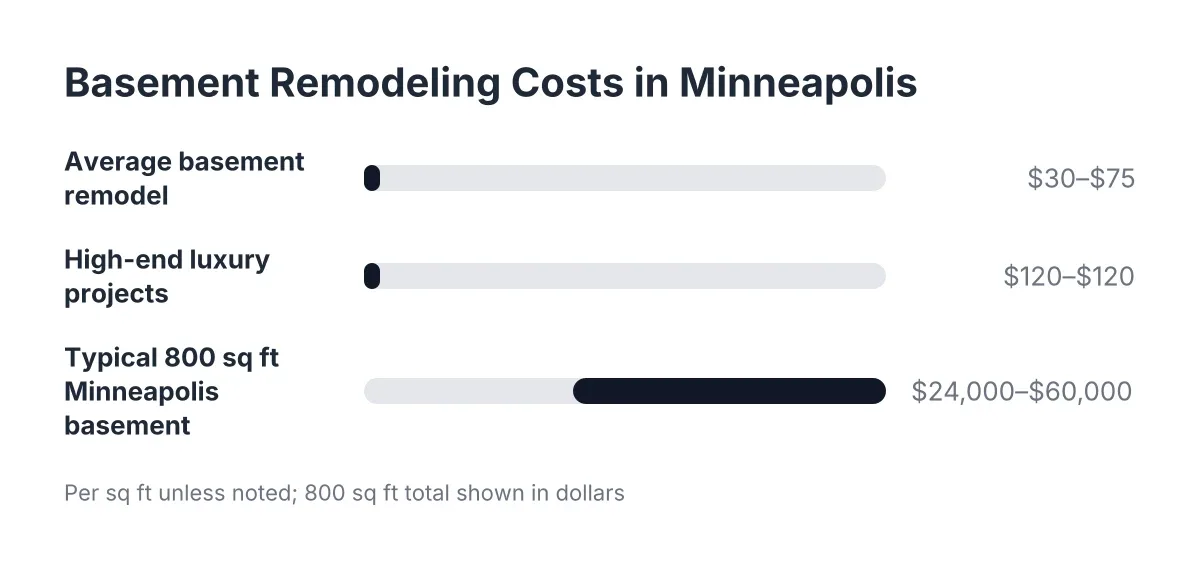
Let's start with the honest answer: it depends, but not in the hand-wavy way that phrase usually implies. According to Angi, an average basement remodel runs between $30 and $75 per square foot, with high-end luxury projects exceeding $120 per square foot. For a typical 800-square-foot Minneapolis basement, that puts most projects somewhere between $24,000 and $60,000. That range feels wide because it is. The difference comes down to what your basement needs before finishing begins and what you want when it is done.
To put it simply, a basic finish covers a few core essentials:
- Framing and insulation
- Drywall and paint
- Electrical work
- Flooring
That scope of work usually lands near the lower end of the range. Add a bathroom, a wet bar, an egress window for a legal bedroom, or custom built-ins, and you move up quickly. Beyond that, the condition of your existing basement matters. A dry basement with decent ceiling height and an accessible layout costs less to finish than one that needs moisture correction, ductwork rerouting, or foundation repairs first.
Why Minneapolis Basements Cost What They Do
Minneapolis adds its own variables. Our freeze-thaw cycles and clay-heavy soils make moisture management non-negotiable, not optional. As a result, a responsible local contractor will address drainage, vapor barriers, and climate-rated insulation before hanging a single sheet of drywall. Skipping that step saves money now and costs far more later.
Additionally, egress requirements shape budgets here. If you want a bedroom in your finished lower level, Minnesota building code requires an egress window. Cutting through a foundation wall, installing the window, and building the window well adds real cost. However, it also adds a legal bedroom, which changes how appraisers and buyers value your home. For a growing family planning around a new baby or a teenager who needs their own room, that trade-off usually makes sense.
The best way to pin down your number is an itemized estimate based on your actual space. In practice, that means measurements, a moisture assessment, and a line-by-line breakdown rather than a single lump-sum figure scribbled on a business card.
What Drives Basement Renovation Prices Up or Down
Every basement project's budget rises or falls based on a handful of decisions. Understanding them before you get estimates puts you in control of the conversation instead of reacting to numbers you did not expect.
The Big Cost Drivers
Several factors tend to swing the total more than anything else:
- Plumbing location — Adding a bathroom is one of the most valuable upgrades you can make, but it depends heavily on where your existing drain lines sit. If your basement already has a rough-in, you might add a full bath affordably. If it does not, you may need to break concrete and install an ejector pump, which adds meaningfully to the bottom line.
- Ceiling height and mechanicals — Low-hanging ductwork, plumbing runs, and beams force decisions. You can box them in cheaply, reroute them at moderate cost, or in rare cases lower the floor at significant expense.
- Electrical capacity — Older Minneapolis homes often need panel upgrades to handle a finished basement's new circuits. That is not a corner worth cutting.
- Flooring choice — Luxury vinyl plank handles moisture well and stays budget-friendly. Carpet with a proper subfloor costs more but feels warmer underfoot during a Minnesota January. Tile and engineered wood push higher still.
None of these choices is wrong on its own. The right answer depends on how your family will use the space.
Where You Can Save Without Regret
That said, an affordable basement finish does not mean a cheap one. You can save real money by keeping the layout simple, placing bathrooms near existing plumbing, choosing an open floor plan over many small rooms, and selecting mid-range finishes. Each of those choices trims cost without compromising the build quality behind the walls.
Conversely, never economize on moisture control, insulation, electrical work, or egress compliance. Those items protect your investment and your family. A cheap finish that grows mold behind the drywall in a few years becomes the most expensive basement you can buy. With this in mind, ask every contractor you interview to separate their estimate into structure-and-systems versus finishes. The first category is where quality lives. The second is where you have room to flex.
Budgeting, Financing, and What You Get Back
Knowing the price is half the battle. The other half is fitting a lower-level renovation into your family's actual finances and understanding what the project returns over time.
Building a Realistic Budget
Start with the number you can comfortably spend, then work backward. Additionally, build in a contingency of 10 to 15 percent for surprises. Basements hide things, and even a careful pre-project inspection cannot see through concrete. A contingency turns a mid-project discovery from a crisis into a line item.
Next, prioritize ruthlessly. For a growing family, a legal bedroom and a second bathroom usually deliver more daily value than a home theater or wet bar. You can phase the nice-to-haves instead of paying for everything at once. For instance, many homeowners rough in plumbing for a future bathroom during the initial build, then finish it a year or two later when the budget recovers. Smart sequencing spreads cost without redoing work.
Financing options range from home equity loans and HELOCs to cash-out refinancing and contractor-arranged financing. Each carries different rates, terms, and risk profiles. Because a finished lower level adds livable square footage, many homeowners find that equity-based financing aligns well with the value the project creates. Talk to your lender early so financing does not stall the project after you have committed.
What the Investment Returns
Here is where the numbers get encouraging. The National Association of Realtors Remodeling Impact Report found that homeowners recover 64% of finishing costs at resale, one of the highest percentages among the 20 home improvement projects studied. However, returns vary widely by market. Zonda and the Journal of Light Construction report resale recoup ranging from as little as 23% in some areas to 80 to 86% in others, so local conditions matter. In a tight Minneapolis housing market where families compete for finished square footage, a well-executed project tends to perform well.
Beyond resale math, consider the living value. In the same NAR report, homeowners gave basement finishing a joy score of 9.5 out of 10. That number reflects something spreadsheets miss: the daily relief of a playroom that contains the toys, a guest room for visiting grandparents, or a quiet office below the household chaos. For families outgrowing their main floor, that return starts the day the project finishes and compounds every year you stay in the home.
How to Compare Estimates Without Getting Burned
Once you understand cost drivers and budgets, you will start collecting estimates. This is where many homeowners go wrong, because the lowest number is not automatically the best deal.
A few checkpoints will keep you from getting burned:
- Insist on itemized estimates. A single lump sum tells you nothing about what is included. A line-by-line breakdown lets you compare contractors on the same scope. If one bid is dramatically lower, the itemization usually reveals why: thinner insulation, no moisture barrier, allowance-grade fixtures, or scope quietly left out.
- Ask specifically about moisture strategy. Any contractor working in Minneapolis should explain, without prompting, how they will handle vapor barriers, drainage, and insulation for our climate. A vague answer here is a red flag, no matter how attractive the price. The Environmental Protection Agency's guidance on moisture control in buildings is a useful reference point for why this matters so much below grade.
- Verify permits and code compliance. Egress windows, electrical work, and plumbing all require permits in Minneapolis. A contractor who suggests skipping permits transfers risk to you, and unpermitted work can complicate insurance claims and derail a future home sale.
Local Contractor vs. National Franchise
Finally, weigh who you are actually hiring. National basement-finishing networks standardize their systems and route your lead to whoever is on call. That model works fine for predictable projects. However, Minneapolis basements are rarely predictable. Century-old foundations, mixed-era mechanicals, and our specific soil and frost conditions reward a contractor who has finished basements in your neighborhood, not just basements in general.
A local contractor should also give you straight answers before asking for a commitment. That means clear information on egress requirements, honest flooring recommendations for your moisture conditions, and a layout conversation grounded in how your family lives. If the first meeting feels like a sales pitch instead of an assessment, keep looking. The right partner treats the estimate as the start of a working relationship, not the close of a sale.
Ready to Get Started?
You now know what drives the cost of finishing a basement in Minneapolis, where to spend, and where to save. The next step is a number specific to your space, not a national average. Request a free estimate and get a clear, itemized breakdown before you commit to anything.