
Hiring a Basement Contractor — Complete Guide
basement finishing contractors — The Complete Guide
Choosing between basement finishing contractors is the single biggest decision in your entire remodel. The right contractor turns your unfinished lower level into real living space for your growing family. The wrong one leaves you with change orders, moisture problems, and a project that stalls for months. This guide gives you a Minneapolis-based operator's honest take on how to vet contractors, spot red flags, and read a quote before you sign anything. By the end, you'll know exactly what separates a quality local builder from a franchise network or a fly-by-night crew, and you'll know what questions to ask before hiring a basement contractor at all.
What You'll Find in This Guide
Coming soon — we're building out this topic cluster.
How to Vet Basement Finishing Contractors Before You Sign Anything
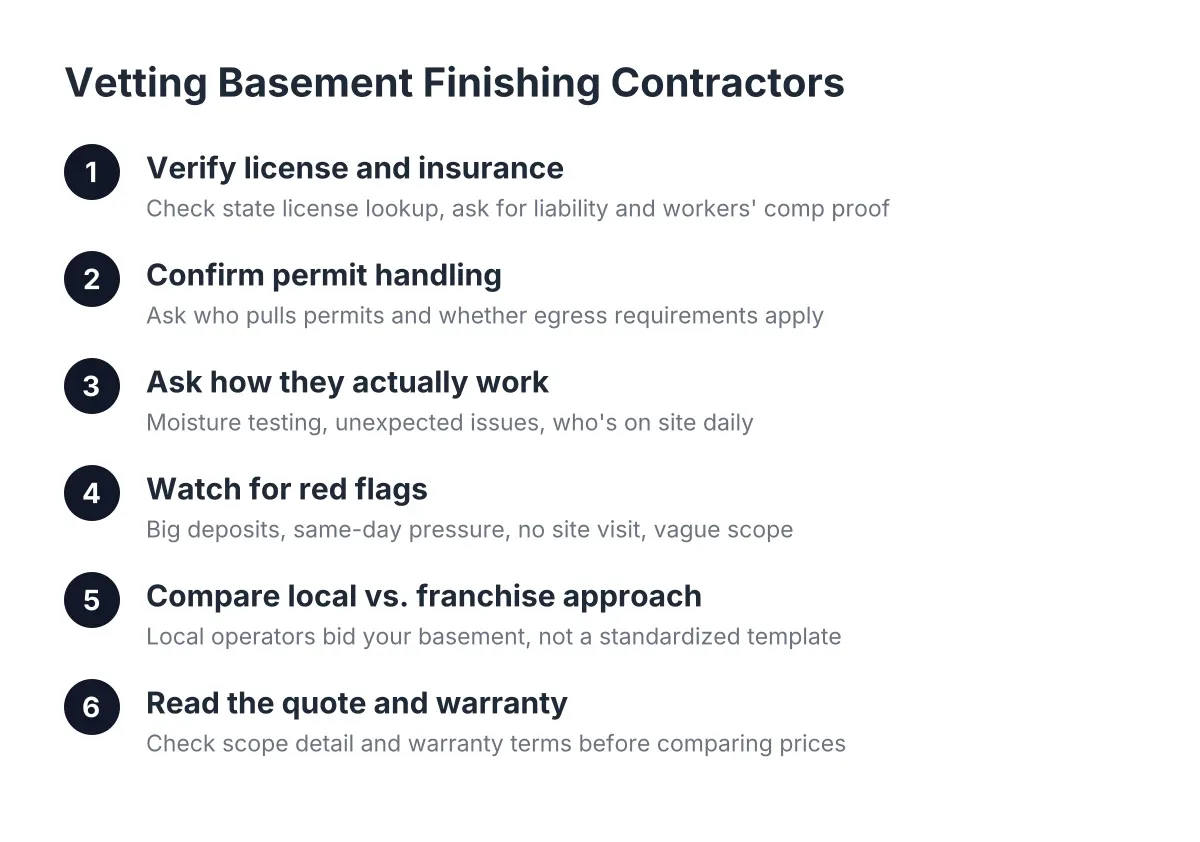
Most homeowners hire a basement contractor once, maybe twice, in a lifetime. That means you're comparing bids without much experience to lean on. However, a few checks can tell you almost everything you need to know before a single wall goes up. In practice, the vetting process for basement finishing contractors comes down to three things: credentials, communication, and honesty about cost.
Start with the license, insurance, and permit history
In Minnesota, residential remodelers who work on your home need a state license. You can verify any contractor's status through the Minnesota Department of Labor and Industry, which maintains a public license lookup. Take five minutes and do it. Beyond the license, ask for proof of general liability insurance and workers' compensation coverage. A legitimate contractor produces both documents without hesitation.
Additionally, ask how the contractor handles permits. Basement finishing in Minneapolis requires permits and inspections, and egress requirements apply to any bedroom you add. A contractor who suggests skipping permits is telling you exactly who they are. Walk away.
Before you sign anything, confirm the following with every contractor on your shortlist:
- Active state license number, verified independently rather than taken on faith
- Proof of general liability insurance and workers' compensation coverage
- Who pulls the permits, and whether that cost is included in the quote
- Whether egress requirements apply to your project, and how they'll be handled
- A written timeline with milestones, not just a start date
Ask questions that reveal how they actually work
Generic questions get rehearsed answers. Instead, ask questions specific to Minneapolis basements. For example, ask how they handle moisture testing before framing. Ask what they do when they open a wall and find something unexpected. Ask who will actually be on site each day, and whether that person is an employee or a rotating subcontractor.
You should also ask about egress windows early. Any legal bedroom needs one, and adding an egress window costs $3,000 to $7,000 on average, according to HomeGuide. As a result, a contractor who quotes a "bedroom" without mentioning egress is either inexperienced or hiding a cost that will surface later.
Know the red flags
Some warning signs repeat across almost every bad basement project. Watch for a large upfront deposit, pressure to sign the same day, a quote that arrives without a site visit, and vague scope language like "finish basement per discussion." That said, the biggest red flag is a price dramatically lower than every other bid. Someone always pays the difference, and it's usually you, later, in change orders or repairs. Trustworthy basement finishing contractors rarely need pressure tactics to win your business — their work speaks for itself.
Local vs. Franchise Basement Contractors: Why It Matters in Minneapolis
When you search for basement contractors, national franchise networks dominate the results. Their websites look polished, and their sales process runs like clockwork. However, the structure behind that polish deserves a closer look before you hand over your basement.
How franchise basement systems actually operate
Franchise networks standardize everything. They sell a proprietary wall system, a fixed product lineup, and a sales presentation designed to close in one visit. Your lead gets routed to whichever affiliate or rep is on call in your territory. In practice, that means the person quoting your project may have never finished a basement in your neighborhood. It also means the system, not your home, drives the design. If your layout doesn't fit their panels, the layout changes instead of the panels.
Standardization isn't automatically bad, and for some projects it works fine. But Minneapolis basements are not standard. Many local homes date from the early and mid 1900s, with fieldstone or block foundations, low ceilings, aging drain tile, and freeze-thaw moisture cycles that a national playbook doesn't account for. A contractor who works these basements every week reads the conditions differently than one following a corporate checklist.
What a local operator does differently
A local basement finishing contractor bids your basement, not a template. That starts with an in-person walkthrough where someone actually looks at your foundation walls, checks for efflorescence and past water intrusion, measures ceiling height against code, and talks through where an egress window can realistically go. Additionally, a local operator knows Minneapolis inspectors, permit timelines, and the code interpretations that trip up out-of-town crews.
There's also a simple accountability difference. A local contractor's reputation lives and dies on referrals within a few zip codes. A franchise affiliate can burn through a territory and rebrand. With this in mind, ask any contractor you interview how many of their projects came from referrals, and ask for addresses of finished basements you can see. Local operators answer that question easily; networks usually can't.
None of this means every local crew is good, or every franchise is bad. Instead, it means the questions in the previous section matter even more when a national brand is doing the selling.
What a Fair Basement Remodel Quote Looks Like
Price is where most homeowners get lost. Bids for the same basement can vary by tens of thousands of dollars, and it's rarely obvious why. Understanding how quotes are built protects you far better than simply picking the middle number.
Anchor yourself with realistic numbers
Nationally, an average basement remodel runs between $30 and $75 per square foot, with high-end luxury builds exceeding $120 per square foot, according to Angi. Your number depends on scope. For instance, a basement bathroom adds plumbing rough-in costs, and a legal bedroom adds egress. Flooring choice, ceiling treatment, and layout complexity all move the total. Consequently, a quote can only be as accurate as the scope behind it.
The good news is that the investment tends to pay off in two ways. Homeowners gave basement finishing a joy score of 9.5 out of 10 in the NAR Remodeling Impact Report. Moreover, the same National Association of Realtors report found that basement finishing recovers 64% of its cost at sale, one of the highest recovery rates among the 20 projects studied. You get space your family uses every day, plus meaningful value back later.
Read the scope, not just the bottom line
A fair quote itemizes the entire project rather than burying it in one number. Look for these components broken out individually:
- Framing, electrical, and plumbing rough-in
- Insulation and vapor barrier approach
- Drywall, paint, and trim
- Flooring, with specific materials named rather than "standard flooring"
- Egress window work, if a bedroom is part of the plan
- Who pulls permits and who pays for them
- A payment schedule tied to completed milestones, not calendar dates
A one-page quote with a single lump sum tells you nothing. When something goes wrong, and something always comes up in a basement, that vague document gives you no leverage. This is precisely where the best basement finishing contractors differentiate themselves from the rest of the field — their paperwork matches their promises.
Ask about the warranty before you compare prices
Warranty terms separate serious basement finishing contractors from crews chasing the next job. Ask what the workmanship warranty covers, how long it lasts, and who honors it. This matters especially with franchises, where the entity that sold you the project may not be the entity responsible for fixing it. In contrast, a local contractor's warranty is only as good as their intention to still be here in ten years. Ask how long they've operated under the same name, then ask for a warranty claim they've actually honored. The answer tells you plenty, and it usually tells you faster than any brochure could.
Ready to Get Started?
If you're comparing basement finishing contractors in Minneapolis, start with a conversation, not a sales pitch. We'll walk your basement, give you straight answers on egress, flooring, moisture, and layout, and put a clear, itemized number in front of you. Request your free estimate and see the difference a local operator makes.